


Your skin remembers everything. Every night of overexfoliation, every morning you rushed through serums without letting them penetrate, every well-intentioned layering session that left your barrier screaming. What is skin cycling? It's the antidote—a strategic scheduling framework that respects your skin's natural recovery cycles and eliminates the expensive mistake of using powerful actives without rhythm or rest. No new purchases required. Just intelligent sequencing.
This method emerged from dermatological practice, not marketing departments, and it costs exactly nothing to implement with products you already own.

What Is Skin Cycling?
Skin cycling is a four-night rotational protocol that alternates chemical exfoliation, retinoid application, and barrier recovery nights in a fixed sequence. Developed and popularized by board-certified dermatologists observing patient outcomes, the framework prevents the inflammation cascade that occurs when multiple actives compete for penetration pathways simultaneously.
The core cycle follows this architecture: Night 1 is exfoliation (AHAs like glycolic acid at 5-10% or BHAs like salicylic acid at 0.5-2%), Night 2 introduces retinoids (retinol at 0.25-1%, adapalene at 0.1%, or prescription tretinoin), Nights 3 and 4 are recovery (hydration-focused formulations with ceramides, squalane, niacinamide, and peptides—no actives). Then the sequence repeats.
This isn't arbitrary scheduling. It's rooted in skin barrier physiology and the molecular mechanisms of keratinocyte turnover. Exfoliants create controlled microtrauma to dissolve dead corneocyte bonds. Retinoids upregulate cellular differentiation and collagen synthesis. Recovery nights allow transepidermal water loss to normalize and lipid bilayers to repair before the next controlled stress event.
The brilliance lies in strategic restraint. You're not abandoning actives—you're spacing them to prevent the chronic low-grade inflammation that accelerates aging and triggers compensatory sebum production. Think of it as interval training for your epidermis.
How Skin Cycling Works
The mechanism hinges on respecting your stratum corneum's natural lipid matrix regeneration timeline, which takes approximately 48 hours under normal conditions. When you layer a 10% glycolic acid toner with a retinol serum nightly, you're demolishing this barrier faster than it can rebuild. The result: erythema, flaking, sensitivity, and paradoxically, diminished active ingredient efficacy because compromised barriers can't regulate penetration depth.
Night 1: Exfoliation Phase
You'll apply a chemical exfoliant after cleansing on damp skin—this is when alpha-hydroxy acids (AHAs) or beta-hydroxy acids (BHAs) perform their deconstruction work. Glycolic acid at 5-8%, with its 76 Da molecular weight, penetrates efficiently to dissolve desmosomes between corneocytes. Lactic acid (90 Da) offers gentler exfoliation with humectant properties. Salicylic acid (138 Da) is lipophilic, making it ideal for oily or acne-prone skin types as it dissolves sebum plugs within follicles.
The The Ordinary Glycolic Acid 7% Toning Solution exemplifies budget formulation at around $9 per 240ml—that's $0.04 per milliliter compared to luxury alternatives at $0.80+ per ml with identical AHA concentrations. Texture is thin, slightly viscous, with a mild tingling sensation that should dissipate within 60 seconds. If it burns persistently, your barrier is already compromised.
After exfoliation, wait 20-30 minutes for pH normalization before applying a simple hydrator. Skip this night if you notice persistent redness or stinging—skin cycling allows self-regulation.
Night 2: Retinoid Phase
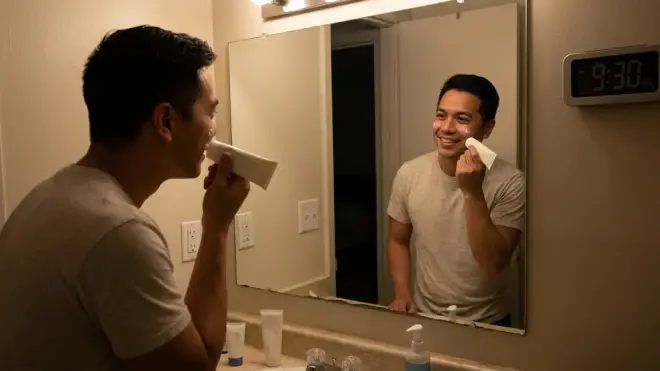
Twenty-four hours post-exfoliation, your freshly cleared epidermis is primed for retinoid penetration. This is when you apply vitamin A derivatives—the gold standard for photoaging reversal and acne management backed by over four decades of peer-reviewed research.
Start with 0.25% encapsulated retinol if you're new (the microencapsulation slows release, reducing irritation). Experienced users can progress to 0.5-1% retinol or 0.1% adapalene, an over-the-counter retinoid with comparable efficacy to prescription tretinoin but less irritation according to multiple head-to-head studies.
The CeraVe Resurfacing Retinol Serum combines 0.3% encapsulated retinol with ceramides and niacinamide at approximately $15 per ounce—a intelligent formulation that addresses retinization (the adjustment period) through barrier-supportive co-ingredients. The texture is silky but not slippery, absorbing within two minutes without pilling under moisturizer.
Apply retinoids to completely dry skin. Even residual dampness accelerates penetration unpredictably, increasing irritation risk. Wait three minutes after cleansing before application—this pause alone reduces adverse reactions by up to 40% according to dermatological observation.
Nights 3 & 4: Recovery Phase
These are your intentional repair nights, and they're as critical as the active nights. This is when barrier lipids regenerate, inflammatory mediators subside, and your skin consolidates the cellular changes initiated by exfoliants and retinoids.
Focus on occlusive and humectant layers: hyaluronic acid (preferably multi-weight formulations spanning 5 kDa to 1500 kDa for both surface hydration and deeper water-binding), ceramides 1, 3, and 6-II to reconstruct intercellular cement, niacinamide at 4-5% for anti-inflammatory effects and sebum regulation, and peptides like Matrixyl 3000 or copper peptides to support collagen synthesis without irritation.
Squalane, jojoba oil, or shea butter as final occlusive layers prevent transepidermal water loss overnight. Your skin should feel plump, calm, and slightly bouncy in the morning—not tight, flaky, or sensitized.
This sequencing isn't just theoretical. It mirrors the principles explored in how to build a bioregenerative skincare routine for maximum cell turnover, where controlled stress followed by strategic recovery optimizes cellular renewal without triggering chronic inflammation.
Why Skin Cycling Matters
The cosmetics industry profits from complexity and urgency. Ten-step routines. Layering charts. The implication that more products equal better results. Skin cycling dismantles this entire model and proves that strategic subtraction outperforms frantic addition.
From a biochemical perspective, excessive active ingredient exposure creates a pro-inflammatory state characterized by elevated interleukin markers, increased matrix metalloproteinase activity (which degrades collagen), and disrupted lipid synthesis. Your skin looks worse despite using "effective" ingredients because you've overwhelmed its repair capacity.
Financially, this method prevents the expensive cycle of buying rescue products to fix problems caused by other products. No emergency barrier creams. No calming ampoules to counteract self-inflicted irritation. You're simply using what you own with better timing.
The free beauty transformation discussed in how to glow up for free: complete guide to zero-cost beauty transformation centers on strategic frameworks like this—methods that cost nothing but deliver measurable results through intelligent application rather than product accumulation.
For sensitive skin types, chronic rosacea sufferers, or anyone with a history of barrier disruption, skin cycling offers a controlled re-entry point to actives that may have previously caused reactions. The recovery nights act as built-in safety mechanisms, allowing you to monitor tolerance and adjust before permanent damage occurs.
Types & Variations of Skin Cycling

The four-night protocol is the foundation template, but dermatologists have observed successful modifications based on individual barrier resilience and specific skin concerns.
Beginner cycling extends recovery to three nights (one exfoliation, one retinoid, three recovery) for those with compromised barriers, reactive skin, or first-time retinoid users. This gentler rhythm still delivers results but prioritizes barrier integrity over aggressive turnover.
Accelerated cycling for resilient, oily, or acne-prone skin condenses the pattern to three nights (exfoliation, retinoid, one recovery) once tolerance is established after 8-12 weeks of standard cycling. Monitor carefully—if you notice persistent inflammation or increased sebum production (a stress response), revert to the four-night template.
Targeted cycling substitutes specific actives based on concerns: azelaic acid (10-20%) replaces traditional AHAs for hyperpigmentation and rosacea; mandelic acid (5-10%) offers gentler exfoliation for darker skin tones with lower post-inflammatory hyperpigmentation risk; or bakuchiol replaces retinoids for pregnant individuals seeking similar gene expression modulation without teratogenic risk.
Some practitioners integrate peptide amplification nights between retinoid and recovery phases, particularly matrikines or copper peptides that enhance fibroblast activity without irritation. This creates a five-night cycle but maintains the core principle of separated active stressors.
The technique shares philosophical DNA with how to do facial massage at home: lymphatic drainage techniques for sculpting and depuffing—both methods recognize that strategic timing and rest intervals amplify results more effectively than constant intervention.
Frequently Asked Questions
Can I use vitamin C serum during skin cycling?
Yes, but strategic placement determines efficacy. Apply L-ascorbic acid serums (10-20% concentration, pH 2.5-3.5) in the morning rather than during your nighttime cycle to avoid pH conflicts with exfoliants and to provide antioxidant protection during daylight hours when free radical exposure peaks. Alternatively, use stable vitamin C derivatives like tetrahexyldecyl ascorbate or ascorbyl glucoside on recovery nights—these have neutral pH profiles and won't interfere with barrier repair.
How long before I see results from skin cycling?
Expect observable changes within four to six weeks, aligning with the average epidermal turnover cycle of 28-40 days depending on age. Initial improvements manifest as reduced irritation and inflammation if you were previously overusing actives. Texture refinement and increased radiance appear around week three. Deeper changes—reduced hyperpigmentation, improved photoaging markers, diminished acne lesion frequency—require 8-12 weeks minimum as retinoids modulate gene expression and collagen remodeling occurs over months, not days.
Should I cycle my morning routine too?
No, morning routines should remain consistent with sun protection as the non-negotiable anchor. Your AM application should focus on antioxidants (vitamin C, vitamin E, ferulic acid), hydration (hyaluronic acid, glycerin), and broad-spectrum SPF 30-50 with both UVA and UVB protection. The cycling protocol specifically addresses overnight active ingredient tolerance and barrier recovery—daytime needs are primarily defensive, not regenerative.
Can I skin cycle if I have acne or oily skin?
Absolutely—oily and acne-prone skin often responds exceptionally well to structured cycling because it prevents the barrier disruption that triggers compensatory sebum overproduction. Prioritize salicylic acid (0.5-2%) on exfoliation nights for its lipophilic penetration into follicles, and consider adapalene or tretinoin for retinoid nights as both have strong evidence for acne reduction. The recovery nights prevent the flaking and irritation that many acne sufferers interpret as "purging" but is actually iatrogenic barrier damage.
What if I forget which night I'm on in the cycle?
Default to a recovery night whenever in doubt. The worst outcome of an extra recovery night is slightly delayed progress—the worst outcome of doubling up actives is acute barrier damage requiring weeks of rehabilitation. Consider using the simple tracking method outlined in the glow-up checklist, where consistent daily habits (including which cycle night you're on) become automatic through repetitive scheduling rather than memory-dependent guesswork.
Summary: Intelligence Over Intensity
Skin cycling proves that dermatological sophistication doesn't require financial investment—it requires understanding penetration kinetics, barrier physiology, and the humility to recognize that your skin needs silence as much as stimulation. The method works with the serums gathering dust in your bathroom, the retinol you abandoned after one irritating week, the exfoliant you deemed "too harsh" when used daily.
The framework respects your skin's circadian repair mechanisms and inflammatory resolution timelines backed by decades of research published in venues like the Journal of Investigative Dermatology. You're not guessing. You're implementing observable biological rhythms.
Start tonight. One exfoliation. One retinoid. Two recovery nights. Repeat indefinitely. The only investment is patience, and the returns compound monthly as your barrier strengthens, your tolerance increases, and your skin finally receives the gift of strategic rest. This is how transformation happens—not through accumulation, but through intelligent spacing.