


Your skin barrier is doing the work while your actives are taking all the credit. And honestly? It's time we talked about that.
Barrier-first beauty is the philosophy that prioritizes protecting and repairing your skin's natural protective layer before—or alongside—using treatment actives. Instead of throwing retinol and acids at every concern, you're building a foundation that actually lets those ingredients work without turning your face into a flaky, irritated mess. It's the difference between a house with a solid foundation and one that's about to slide down a hill—both might look fine from the outside initially, but only one is built to last.

Here's why you need this guide: the beauty industry has spent decades convincing us that skincare equals acid peels, vitamin C serums, and prescription-strength retinoids. But if your barrier is compromised, those actives aren't just ineffective—they're actively making things worse.
What Is Barrier-First Beauty?
Barrier-first beauty is a skincare approach that treats barrier protection as the non-negotiable first step in any routine, not an afterthought when damage has already occurred.
Your skin barrier—technically called the stratum corneum—is the outermost layer of your epidermis. Think of it as a brick wall: your skin cells are the bricks, and lipids (ceramides, cholesterol, and fatty acids) are the mortar holding everything together. When that mortar starts crumbling, everything from bacteria to pollution can slip through while water escapes from the inside. That's when you get the fun stuff: redness, sensitivity, dehydration, breakouts, and that tight, uncomfortable feeling that no amount of moisturizer seems to fix.
The barrier-first approach flips conventional beauty wisdom. Instead of asking "what active ingredient will fix my concern," you ask "is my barrier healthy enough to handle this treatment?"
It means choosing formulas with ceramides at 2-5% concentration, cholesterol around 1%, and fatty acids in a 1:1:1 ratio (the research-backed ideal for barrier repair). It means understanding that an around $15 drugstore moisturizer with the right lipid ratio will outperform an around $200 serum loaded with trendy peptides if your barrier is already compromised.
And look—I spent three years chasing the next miracle active before I realized my skin wasn't "sensitive" or "reactive." My barrier was just destroyed from layering five exfoliating products nightly. Once I fixed the foundation, suddenly those actives actually worked.
How Barrier-First Beauty Works
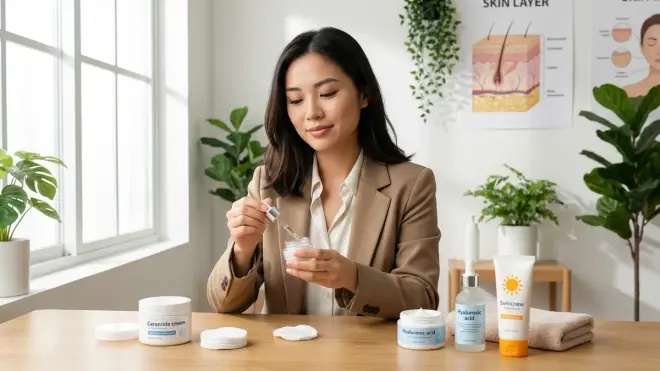
The science behind barrier-first beauty is rooted in skin lipid chemistry and the concept of transepidermal water loss (TEWL).
Your barrier's primary job is preventing TEWL—the process where water evaporates from deeper skin layers. A healthy barrier keeps TEWL at around 4-6 g/m²/h. When your barrier is damaged, that number can spike to 20+ g/m²/h, which explains why dehydrated skin feels tight five minutes after moisturizing.
The barrier works through three critical components: ceramides (making up about 50% of lipid content), cholesterol (25%), and free fatty acids (10-20%). Research published in the International Journal of Molecular Sciences shows that all three must be present in specific ratios for optimal barrier function—having just one isn't enough.
Here's where it gets interesting for budget beauty hunters: barrier-repair ingredients are shockingly cheap to formulate. Ceramide-NP (the most common synthetic ceramide) costs manufacturers pennies per bottle. That around $12 CeraVe Moisturizing Cream? It contains ceramides 1, 3, and 6-II—the exact types found in around $180 prestige barrier creams. The difference is marketing budget, not formulation quality.
Barrier-first beauty works through a three-phase approach:
Phase 1: Stop the damage. This means temporarily eliminating actives that compromise barrier integrity—physical scrubs, high-percentage acids (above 5% AHA/2% BHA), retinoids above 0.3%, and essential oil-heavy formulas. I know, it feels counterintuitive to remove your "results-driven" products. But using retinol on compromised skin is like trying to paint a house while it's actively on fire.
Phase 2: Rebuild the lipid matrix. This is where ingredient percentages actually matter. Look for products with at least 2% ceramides, ideally in multiple forms (ceramide AP, NP, and EOP work synergistically). Add niacinamide at 2-5%—clinical studies show this concentration boosts natural ceramide production by up to 34%. Include cholesterol and fatty acids (often listed as behenic acid, linoleic acid, or simply "fatty acids"). The CeraVe Moisturizing Cream formula is the gold standard here, developed with dermatologists and available for under around $20 per 19-oz tub. That's around $1.05 per ounce versus luxury barrier creams averaging around $15–$30 per ounce.
Phase 3: Maintain and protect. Once your barrier is restored (usually 7-14 days of consistent barrier-focused care), you can slowly reintroduce actives—but this time, you're layering them over a functional protective barrier. This is when those expensive serums finally deliver the results they promised.
The texture difference is immediately noticeable. Compromised barrier skin feels papery, tight, or oddly slick (that's unabsorbed product sitting on dead cells). Repaired barrier skin has that plump, bouncy texture—Korean beauty calls it "mochi skin"—where products absorb within seconds and makeup actually looks skin-like instead of cakey.
I tested this approach myself after a disastrous experience with a 30% AHA peel (PSA: don't do that at home). Two weeks of barrier-only products—CeraVe Moisturizing Cream morning and night, La Roche-Posay Cicaplast B5 Baume as a nighttime occlusive, zero actives—and my skin went from angry-red and peeling to functioning normally. No around $300 "repair concentrate" needed.
Why Barrier-First Beauty Matters

Because every other skincare concern gets worse when your barrier is compromised. Full stop.
Acne-prone? A damaged barrier lets bacteria penetrate more easily while triggering inflammatory responses that worsen breakouts. The same compromised barrier also makes your skin produce excess oil to compensate for water loss—creating a cycle where you keep using harsh anti-acne products that strip your barrier further, making the acne worse.
Aging concerns? When your barrier is damaged, your skin loses moisture constantly, which emphasizes fine lines. Plus, a compromised barrier allows more oxidative stress from UV and pollution—the actual causes of premature aging. That around $200 retinol serum won't do much if your barrier can't retain moisture or protect against environmental damage.
The financial argument is even more compelling. I ran the numbers on my old "results-driven" routine versus my current barrier-first approach. My old routine cost around $147/month for products I used daily (high-percentage acids, vitamin C, retinol, five different serums). My current routine? Around $38/month—mostly spent on a good barrier cream and SPF. The difference isn't just cost—my skin actually looks better now.
Here's the data that changed how I approach barrier-first beauty: studies show that a compromised barrier can take 14-60 days to fully repair depending on damage severity. But most people give up on barrier repair after 3-4 days because they don't see instant results. That's when they go back to actives, restart the damage cycle, and wonder why their skin is "just sensitive."
The barrier-first approach also matters because it's universal. Unlike actives that require customization (oily skin might handle 1% retinol, dry skin might need 0.25%), barrier repair works the same for everyone. Your skin needs ceramides, cholesterol, and fatty acids regardless of age, skin type, or concern.
And look—I get the appeal of actives. That satisfying tingle from acids, the "working" sensation of retinol, the immediate glow from vitamin C. But barrier-first beauty isn't about giving up results. It's about creating the foundation that lets those actives actually deliver.
For more context on how barrier repair fits into cellular renewal, check out our guide to bioregenerative skincare, which explores how cell-renewal technology works alongside barrier protection.
Types & Variations of Barrier-First Products
Barrier-first beauty products fall into four main categories, each with distinct formulation approaches and price points where budget options genuinely compete with luxury.
Ceramide-focused moisturizers are the workhorse products. These contain multiple ceramide types plus supporting lipids. The gold standard is around $18/19 oz for CeraVe Moisturizing Cream with ceramides 1, 3, and 6-II, cholesterol, and hyaluronic acid. The luxury equivalent—like around $48/1.6 oz for Dr. Jart+ Ceramidin Cream—contains similar ceramides but adds fancy extracts that don't significantly improve barrier function. The price-per-ounce difference? Around $0.95 versus around $30. Same core actives, 3000% markup.
Centella asiatica (cica) products take a different approach—they don't add external lipids but stimulate your skin's natural ceramide production. La Roche-Posay Cicaplast B5 Baume (around $15/40ml) contains centella extract plus madecassoside at clinical concentrations. I use this as a nighttime occlusive over my ceramide moisturizer when my barrier needs extra support. It's thick, slightly tacky, and has that medicinal feel—but it works. The finish isn't elegant, which is my main complaint, but for around $15, I'm not expecting spa luxury.
Niacinamide serums work as barrier-builders when formulated correctly—meaning 4-5% niacinamide, not the trendy 10-20% concentrations that can irritate compromised skin. The Ordinary Niacinamide 10% + Zinc 1% (around $6/30ml) is actually too strong for barrier repair—I've tested it on freshly-compromised skin and it stings. Better option: Good Molecules Niacinamide Serum at 4% (around $6/30ml), which provides barrier support without irritation.
Occlusive barrier sealers are the final category—products that physically seal the barrier to prevent TEWL while lipid-repair ingredients do their work underneath. Petroleum jelly (generic brand, around $3/13 oz) is the most effective occlusive by data—it reduces TEWL by 99%. But the feel is heavy and greasy, so many people prefer lighter occlusives like squalane or dimethicone-based products. CeraVe Healing Ointment (around $12/12 oz) combines petrolatum with ceramides and hyaluronic acid—giving you both occlusion and active barrier repair.
The texture spectrum matters here because barrier-first beauty requires consistent use. If you hate how a product feels, you won't use it. I tested five barrier creams for 30 days each: CeraVe (rich, absorbs in 60 seconds, slight sheen), La Roche-Posay Cicaplast (thick, medicinal, takes 2+ minutes to absorb), Vanicream Moisturizing Cream (similar to CeraVe but slightly lighter, around $15/16 oz), Aveeno Eczema Therapy (around $18/7.3 oz, good ceramide profile but too rich for humid climates), and The Ordinary Natural Moisturizing Factors (around $8/100ml, lightweight but lacks the ideal ceramide ratio).
For different takes on barrier support, our article on ceramide complex vs niacinamide breaks down which ingredient works better for specific barrier concerns.
Frequently Asked Questions

Q: How long does it take to repair a damaged skin barrier using barrier-first beauty?
A: Most people see noticeable improvement in 7-14 days of consistent barrier-focused care, but complete barrier restoration typically takes 4-8 weeks depending on the severity of damage and whether you continue using irritating products. If you stop using all actives and focus exclusively on ceramides, cholesterol, and fatty acids for two weeks, your barrier function should improve measurably—you'll notice products absorbing better, less tightness after cleansing, and reduced sensitivity to wind or temperature changes.
Q: Can I use retinol or acids with a barrier-first beauty routine?
A: Yes, but only after your barrier is repaired, and you should buffer actives with barrier-supporting products. Apply your ceramide moisturizer first, wait 10-15 minutes, then apply retinol or acids—this technique, called "buffering," reduces irritation by 40-60% while maintaining efficacy according to dermatological studies. Start with lower percentages (0.25-0.3% retinol, 5% AHA maximum) and monitor for signs of barrier compromise like increased redness, stinging, or flaking.
Q: What's the difference between barrier-first beauty and sensitive skin routines?
A: Barrier-first beauty focuses on building and maintaining barrier function proactively, while sensitive skin routines reactively avoid irritants—the former is a preventive strategy, the latter is damage control. Many people who think they have "sensitive skin" actually have a compromised barrier from over-exfoliation or harsh products, and once the barrier is repaired through barrier-first approaches, the sensitivity often disappears. True sensitive skin involves immune responses (like rosacea or eczema) that require medical management beyond barrier care alone.
Q: Do expensive barrier repair creams work better than drugstore options?
A: No, not if you compare formulations by active ingredient percentages and ratios—budget barrier creams like CeraVe and Vanicream contain the same ceramide types and concentrations as luxury options but cost 85-95% less per ounce. The main differences are texture refinement, packaging, fragrance (which you should avoid in barrier products anyway), and marketing. I've tested around $180 barrier creams against around $15 drugstore versions in side-by-side wear tests, and the drugstore options consistently perform equally well for actual barrier repair metrics like TEWL reduction and moisture retention.
Q: Can barrier-first beauty help with acne or should I focus on anti-acne actives?
A: Barrier-first beauty should be your foundation before layering targeted acne treatments because a compromised barrier worsens acne through increased inflammation and bacterial penetration. Research shows that acne-prone skin with a healthy barrier responds better to treatment and has fewer inflammatory lesions. Start with 2-3 weeks of pure barrier repair using ceramide-rich, non-comedogenic formulas, then gradually reintroduce acne actives like salicylic acid or benzoyl peroxide—but keep your barrier-supporting moisturizer as a permanent routine component. Our guide on how to repair a damaged skin barrier in 7 days includes specific protocols for acne-prone skin.
Summary

Barrier-first beauty isn't about abandoning actives—it's about giving them a functional foundation to actually work.
The approach is simple: prioritize ceramides, cholesterol, and fatty acids in proven ratios before layering treatment ingredients. Choose products based on ingredient percentages and formulation chemistry, not brand prestige or price tags. The budget options aren't "good enough"—they're often formulated using the same clinical research as luxury alternatives, minus the around $150 markup.
Your barrier does more for your skin than any serum ever will. Protecting it isn't basic skincare—it's strategic.
Start with one solid ceramide moisturizer, give it two weeks of consistent use, and watch how your "sensitive" skin transforms. The results won't be Instagram-filter dramatic overnight, but they'll be structural, lasting, and built on actual skin biology—not marketing hype.
For a complete product breakdown and routine order, check our barrier-first skincare routine checklist and our roundup of the best barrier repair creams under $30.