
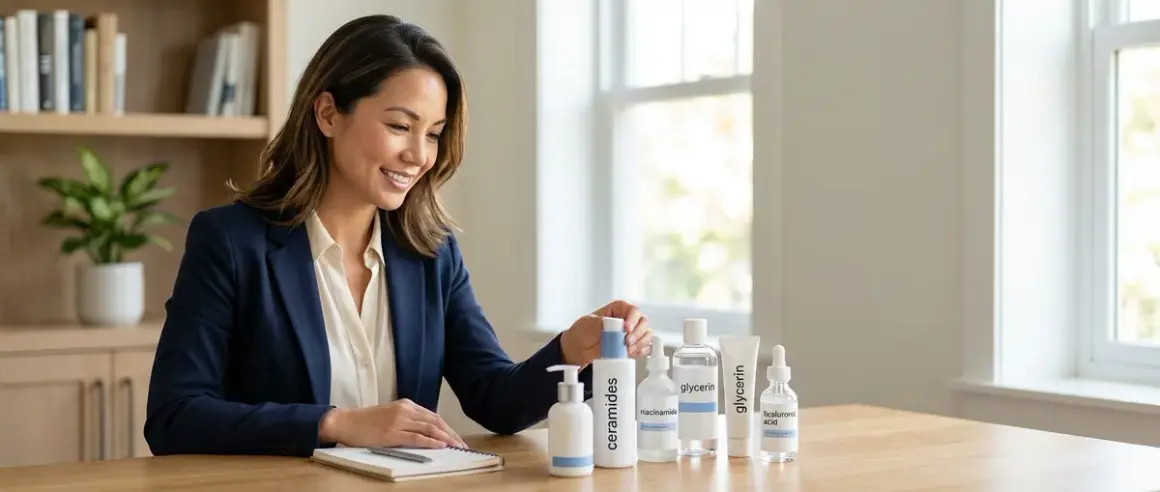

You know that tight, uncomfortable feeling after washing your face? That's your skin barrier screaming for help. Here's the deal: learning how to choose barrier repair ingredients isn't some advanced skincare chemistry course—it's a 10-minute education that'll save you hundreds of dollars and months of trial-and-error. I'm talking about understanding five key ingredient categories, matching them to your actual skin type (not the one a magazine quiz told you), and building a routine that takes less time than your morning coffee ritual.
Time investment: 15 minutes to read this, 5 minutes per day to implement. Skill level: Beginner-friendly. Cost savings: around $200-400 annually by choosing the right ingredients the first time instead of collecting half-used products under your sink.

Let's be real—I spent my first year postpartum buying every "barrier repair" product that Instagram showed me, only to discover my dehydrated-but-oily skin needed completely different actives than the ceramide-heavy creams everyone was raving about. This guide will help you skip that expensive learning curve.
What You'll Need
- Your current skincare products (to check ingredient lists and identify what's missing)
- A basic understanding of your skin type (oily, dry, combination, sensitive—not what you think it should be, but what it actually is right now)
- Your phone or computer (to reference this guide while shopping or checking labels)
- 5 minutes of decent lighting (bathroom lighting lies—check your skin near a window)
- Optional but helpful: a notebook or Notes app to track what works over 2-3 weeks
- A realistic budget range (barrier repair can start at around $8 or hit around $80—knowing your ceiling matters)
Step 1: Identify Your Actual Barrier Damage Level
Before you can learn how to choose barrier repair ingredients, you need to diagnose where your barrier actually stands. Not based on what TikTok told you, but on observable symptoms.
Mild damage looks like occasional tightness after cleansing, makeup that doesn't sit quite right by midday, or products that sting slightly when they never used to. You'll recover with basic humectants and occlusives in 1-2 weeks. Moderate damage means persistent flaking (even with moisturizer), redness that won't quit, or that fun situation where your skin is simultaneously oily and dehydrated—hello, postpartum hormones. This needs ceramides, cholesterol, and fatty acids in specific ratios. Severe damage is when everything burns, your skin looks visibly inflamed, and you're dealing with conditions like perioral dermatitis or extreme sensitivity. This requires medical-grade barrier repair, often with around 4-5% niacinamide and minimal additional actives.
I learned this the hard way when my second pregnancy left me with a compromised barrier that I kept "treating" with retinol because I was desperate about melasma. Spoiler: that made everything worse. Check your skin in natural light—if you see visible texture, persistent redness, or if your moisturizer absorbs instantly and leaves you feeling tight 20 minutes later, you're past the mild stage.
The cost reality: Mild damage can be addressed with around $12 for a Cerave product. Moderate to severe damage performs better with 2-3 targeted products that'll run you around $35-60 total, but that's still less than the dermatologist co-pay you're avoiding.
Understanding what your skin barrier actually is and how it functions will help you make smarter ingredient choices instead of just buying whatever has "barrier repair" on the label.
Step 2: Match Humectants to Your Climate and Skin Hydration Level

Humectants are your moisture magnets—they pull water into your skin. But here's what nobody tells you: the wrong humectant in the wrong climate makes things worse, not better.
Hyaluronic acid is the celebrity humectant everyone knows, but molecular weight matters. Low molecular weight HA (under 50 kDa) penetrates deeper but can feel sticky; high molecular weight (1,000-1,500 kDa) sits on the surface and provides immediate plumping. Most drugstore products don't tell you the molecular weight, which is infuriating, but if a product lists sodium hyaluronate high on the ingredient list, that's typically lower molecular weight. The Ordinary Hyaluronic Acid 2% + B5 ($8) uses multiple molecular weights—it's absurdly cost-effective at $0.27 per ml, though the texture is slightly sticky for about 60 seconds after application.
Glycerin is the workhorse humectant that gets zero hype but performs incredibly in humid climates. It's in almost everything at 2-5% concentrations. The issue? In extremely dry climates (under 20% humidity), glycerin can actually pull moisture from your skin if you don't seal it with an occlusive. I discovered this during a trial in Palm Springs—my glycerin-heavy routine that worked perfectly in coastal California left my skin parched in the desert.
Panthenol (Pro-Vitamin B5) at 2-5% is the underrated choice for damaged barriers because it's both humectant and anti-inflammatory. La Roche-Posay Cicaplast Baume B5 (around $15 for 40ml, $0.38/ml) uses 5% panthenol and works exceptionally well for irritated skin, though the texture is quite thick—not for daytime unless you work from home.
Beta-glucan and polyglutamic acid are the newer humectants showing up in K-beauty and J-beauty formulations. Beta-glucan is particularly good for sensitive skin types because it's calming. The PURITO Deep Sea Pure Water Cream (around $17 for 50ml) uses fermented beta-glucan and costs $0.34/ml—comparable performance to products triple the price.
Match your humectant to your environment: glycerin for humid climates, hyaluronic acid for moderate humidity, and always layer with an occlusive in low humidity.
Step 3: Select Ceramides Based on Ratio, Not Just Presence

This is where learning how to choose barrier repair ingredients gets technical, but I promise it's worth understanding. Your skin barrier has ceramides, cholesterol, and free fatty acids in roughly a 3:1:1 ratio. Products that respect this ratio outperform products that just dump ceramides in random amounts.
Ceramide NP (formerly Ceramide 3) is the most studied and stable form. It shows up in almost every barrier repair product because it's effective and relatively affordable to formulate. Ceramide AP (formerly Ceramide 6-II) helps with exfoliation and cell turnover—good for aging skin. Ceramide EOP (formerly Ceramide 1) is the rarest and most expensive, but it's particularly important for barrier structure.
The gold standard is products with at least three ceramide types plus cholesterol and fatty acids. CeraVe Moisturizing Cream (around $16 for 19oz, $0.03/ml) actually nails this with Ceramides 1, 3, and 6-II plus cholesterol—it's absurdly cheap per ounce, which is why dermatologists won't shut up about it. The downside? The texture is heavy as hell. If you're layering it at night, fine. If you're trying to apply makeup over it at 6 AM before daycare drop-off, good luck.
SkinFix Barrier+ Triple Lipid-Peptide Cream (around $52 for 1.7oz, $1.02/ml) has a more elegant texture with the same lipid ratio plus barrier-supporting peptides. Worth it if you need something for daytime and your budget allows, but the CeraVe performs just as well functionally—you're paying for cosmetic elegance.
Here's what I wish someone had told me earlier: concentration matters more than variety. A product with 2% of three ceramides outperforms a product with 0.5% of six ceramides. Unfortunately, most brands don't disclose percentages. Look for ceramides in the top 10 ingredients on the list—if they're near the end after all the preservatives, the amount is likely negligible.
If you're dealing with moderate to severe barrier damage, check out the best barrier repair creams under $30 for detailed formulation comparisons.
Step 4: Add Niacinamide at the Right Percentage for Your Tolerance
Niacinamide is the multitasker that supports barrier function, reduces inflammation, helps with hyperpigmentation, and regulates oil production. It's in everything now, but percentage and formulation quality vary wildly.
The sweet spot is 4-5% for barrier repair—this is supported by actual dermatological research published in the British Journal of Dermatology. Below 2%, you're getting minimal barrier benefits. Above 10%, you're increasing the risk of irritation with no additional benefit. Despite this, plenty of brands are pushing 10-20% niacinamide serums because higher numbers sell, even when they're unnecessary.
Good Molecules Niacinamide Serum (around $6 for 30ml, $0.20/ml) uses 10% niacinamide—it's incredibly affordable, but I found it slightly irritating when my barrier was compromised. I use it now that my skin is healthy, but during recovery, I needed something gentler. The Inkey List Niacinamide (around $7 for 30ml, $0.23/ml) uses 10% as well and includes 1% hyaluronic acid, but same issue—too strong when your barrier is already angry.
Paula's Choice 10% Niacinamide Booster (around $44 for 20ml, $2.20/ml) is absurdly expensive per ml, and while the texture is beautiful and it includes chromabright for hyperpigmentation, you're not getting better niacinamide—just fancier packaging. I tested this during a particularly good billing month and couldn't justify the repurchase.
For compromised barriers, start with 4-5% formulations. The CeraVe PM Facial Moisturizing Lotion (around $14 for 3oz, $0.16/ml) has 4% niacinamide plus ceramides—it's the efficiency play if you want both ingredient categories in one step. The texture is lightweight enough for morning use, though it pills slightly under some sunscreens.
Sensitive skin types should patch-test niacinamide even at lower percentages. About 5% of people experience mild irritation or flushing, especially when combining it with vitamin C or acids. If you're already dealing with damaged barrier, introduce niacinamide after you've calmed inflammation with other ingredients, not as your first step.
Understanding how niacinamide compares to other barrier actives helps too—see ceramide complex vs niacinamide for performance benchmarks.
Step 5: Choose Occlusives Based on Texture Tolerance and Daytime Needs

Occlusives seal everything in—they're your barrier's security system. But choosing the right occlusive for how to choose barrier repair ingredients depends entirely on when you're applying it and what you can tolerate texture-wise.
Petrolatum is the gold standard with 98% occlusion rates according to testing standards. Aquaphor Healing Ointment (around $7 for 3.5oz, $0.07/ml) is pure petrolatum-based efficiency—it's greasy as hell, so this is strictly a nighttime or spot-treatment product unless you're staying home. I use it on particularly dry patches around my nose and chin at night. It's gross and you'll stick to your pillowcase, but nothing else keeps moisture sealed in quite like it.
Squalane provides moderate occlusion (about 30-40%) with a much more elegant texture—it's technically a plant-derived hydrocarbon that mimics your skin's natural oils. The Ordinary 100% Plant-Derived Squalane (around $8 for 30ml, $0.27/ml) is pure squalane and absorbs fully within 2-3 minutes. I use this before makeup when my skin needs extra protection but I can't look like I smeared Vaseline on my face before court. The only annoyance is the dropper dispenses more than you need—you'll waste product if you're not careful.
Dimethicone is a silicone-based occlusive that works beautifully under makeup and provides about 50% occlusion. It's in most primers for good reason—it creates a smooth, non-greasy barrier. Look for it in the top 5 ingredients for meaningful occlusion. CeraVe Skin Renewing Night Cream (around $17 for 1.7oz, $0.33/ml) uses dimethicone plus ceramides—great for nighttime if you want occlusion without the petroleum grease.
Shea butter and ceramide-based occlusives offer moderate occlusion with barrier-repair benefits built in. Stratia Liquid Gold (around $28 for 60ml, $0.47/ml) is a cult favorite in Reddit skincare communities for good reason—4% niacinamide, ceramides, cholesterol, and sea buckthorn oil in an elegant liquid texture. It's manufactured in small batches in the US and the formulation matches much more expensive options. The downside? It goes out of stock regularly, which is frustrating when you're trying to maintain a consistent routine.
Daytime strategy: Use lighter occlusives like squalane or dimethicone-based products that won't interfere with sunscreen or makeup. Nighttime strategy: Go heavier with petrolatum-based occlusives or thick ceramide creams—this is when maximum occlusion matters since you're not worried about appearance.
The barrier-first beauty approach emphasizes proper occlusion as the final step in any repair routine.
Step 6: Incorporate Soothing Actives for Inflammation Management

If your barrier is damaged, it's almost always inflamed—and inflammation prevents repair. Learning how to choose barrier repair ingredients means including anti-inflammatory actives, not just moisture.
Centella asiatica (cica/madecassoside) is probably the best-studied soothing ingredient in barrier repair. It speeds wound healing and reduces inflammation at concentrations as low as 0.1%. Purito Centella Green Level Buffet Serum (around $17 for 60ml, $0.28/ml) has 49% centella extract—the texture is watery and layers beautifully under other products. I use this every morning during high-stress work weeks when my skin gets reactive. The only issue is the bottle design; the pump occasionally dispenses unevenly.
Colloidal oatmeal at 1-5% is clinically proven to reduce itching and irritation. It's particularly good for eczema-prone or very sensitive skin. Aveeno Eczema Therapy Moisturizing Cream (around $12 for 7.3oz, $0.06/ml) uses colloidal oatmeal plus ceramides—unglamorous packaging, incredible performance for reactive skin. It's thick without being greasy and absorbs within 3-4 minutes.
Bisabolol and allantoin are gentle anti-inflammatory ingredients that show up in K-beauty and European pharmacy brands. They work well for mild sensitivity but aren't strong enough for severe inflammation. Look for them in formulations with other barrier actives rather than relying on them solo.
Azelaic acid deserves a mention here because while it's often positioned as an acne or hyperpigmentation treatment, it's also anti-inflammatory. At 10-20%, it supports barrier function while addressing other concerns. The Ordinary Azelaic Acid 10% (around $9 for 30ml, $0.30/ml) has a slightly gritty texture from the azelaic acid suspension—it takes about 60 seconds to absorb fully and works well under moisturizer. Not my favorite texture, but the price-to-performance ratio is excellent.
For sensitive or reactive skin types, soothing ingredients aren't optional—they're essential. You can layer ceramides all day, but if inflammation is constant, your barrier won't fully repair.
Step 7: Time Your Ingredient Introduction and Layer Correctly
You cannot throw all these ingredients at your face simultaneously and expect magic. When you're learning how to choose barrier repair ingredients, you also need to understand introduction timing and layering order.
Week 1-2: Start with humectants and occlusives only. Your goal is hydration and sealing—nothing fancy. A hyaluronic acid serum followed by a ceramide cream and an occlusive at night. This is the foundation. If your skin is severely compromised, even this might cause some adjustment—tightness, slight stinging—which should resolve within 3-4 days.
Week 3-4: Add niacinamide if your skin has stabilized. Layer it after humectants, before heavier moisturizers. Use it once daily initially, then increase to twice daily if tolerated. If you experience flushing or irritation, drop back to every other day.
Week 5+: Introduce soothing actives or additional barrier support. Centella serums, azelaic acid (if needed), or specialized treatments. By this point, your basic barrier function should be noticeably improved—less tightness, better moisture retention, calmer appearance.
Layering order matters: Thinnest to thickest consistency. Water-based serums (hyaluronic acid, niacinamide) → lightweight creams (ceramide lotions) → heavier creams → occlusives. If you apply a heavy occlusive first, nothing else penetrates.
The impatient person's mistake: I tried to speed this up after my second pregnancy by introducing everything at once. Result? My skin freaked out and I couldn't tell which ingredient was the problem. I had to strip back to basics and start over, which cost me three extra weeks. Don't be me. Patience saves time in the long run.
If you're also dealing with active breakouts or want to incorporate other actives safely, the guide on how to repair a damaged skin barrier in 7 days provides a structured timeline.
Step 8: Adjust Formulations Seasonally and During Stress Events

Your barrier needs change—pregnancy, stress, climate shifts, illness, new medications. Learning how to choose barrier repair ingredients isn't a one-time decision; it's an adaptive skill.
Winter or low-humidity environments demand heavier occlusives and more ceramides. The routine that worked in July might leave you tight and flaking in January. I add a layer of squalane oil between my moisturizer and sunscreen during California's dry winter months (yes, we have those). It adds 30 seconds to my routine but prevents that awful mid-morning tightness.
Summer or high-humidity climates mean you can often reduce occlusive layers and rely more on lightweight humectants. My summer routine is bare-bones: hyaluronic acid serum, a lightweight niacinamide moisturizer, sunscreen. Done. Takes 3 minutes.
Stress events—trial deadlines, illness, postpartum, grief—tank your barrier faster than anything else. During high-stress periods, I eliminate all actives except barrier repair. No retinol, no acids, no "anti-aging" anything. Just hydration, ceramides, and occlusives. Your skin will recover faster with less, not more.
Hormonal fluctuations during menstrual cycles or pregnancy change oil production and sensitivity. Track your cycle if you notice patterns—you might need slightly different formulations during different phases. I use a heavier ceramide cream during the luteal phase when my skin gets sensitive, then switch back to a lighter option when it calms.
Cost implication: You don't need to buy entirely new products for each season. Adjusting layers and amounts of what you already have is free. Add an extra pump of squalane in winter. Skip the heavy night cream in summer. Work with what you have.
Building a sustainable barrier-first routine means understanding these seasonal adjustments—see the barrier-first skincare routine checklist for detailed seasonal protocols.
Pro Tips & Common Mistakes
The biggest mistake I see constantly: treating barrier damage with more actives. If your skin is compromised, retinol will not help, vitamin C will not help, acids will not help. They'll make it worse. Strip back to basics—humectants, lipids, occlusives—and wait for actual repair before reintroducing actives. This probably costs you 2-3 weeks of "progress" on other goals, but it saves you months of further damage.
pH matters for barrier repair products. Your skin barrier functions optimally at pH 4.5-5.5. Cleansers with high pH (8-9, often in bar soaps) strip your barrier daily, then you're trying to repair it with serums. That's like punching a hole in a bucket and wondering why it won't hold water. Switch to a low-pH cleanser (around 5.5) if you're struggling with persistent barrier issues.
Don't confuse hydration with moisture. Hydration is water content (humectants). Moisture is oil/lipid content (occlusives and emollients). Dehydrated skin needs humectants plus occlusives. Dry skin needs lipids and occlusives. Oily-but-dehydrated skin (hello, hormonal chaos) needs humectants and lightweight occlusives, not heavy creams. Getting this wrong means buying products that don't address your actual issue.
Patch-test during barrier repair. Even gentle ingredients can cause reactions when your barrier is compromised. Test new products on your inner arm or behind your ear for 48 hours before full-face application. Yes, this delays your routine by two days. It's still faster than dealing with a full-face reaction.
Price doesn't correlate with barrier repair effectiveness. Some of the most effective barrier repair products are under $15 (CeraVe, Vanicream, Aveeno). You're not missing out on miracle ingredients by shopping at the drugstore. You're potentially wasting money on elegant textures and packaging with luxury brands. Choose based on formulation, not prestige.
The sneaky problem with "barrier repair" marketing: Brands slap that label on products with one ceramide at 0.2% concentration buried in the ingredient list. Actually effective barrier repair requires meaningful concentrations of multiple lipid types. Check ingredient positioning—if ceramides aren't in the top third of the list, they're likely present in insufficient amounts.
Frequently Asked Questions

How long does it take to see results from barrier repair ingredients?
You should notice reduced tightness and improved moisture retention within 7-10 days if you're using properly formulated barrier repair products with adequate ceramides, humectants, and occlusives. Visible improvements in texture, redness, and resilience typically take 3-4 weeks of consistent use, though severe barrier damage may require 6-8 weeks of dedicated repair. The timeline accelerates if you eliminate all irritating actives and harsh cleansers while focusing exclusively on barrier support—trying to repair your barrier while still using retinol or acids is like trying to heal a cut while repeatedly reopening it.
Can I use barrier repair ingredients if I have oily or acne-prone skin?
Yes, barrier repair is essential for oily and acne-prone skin types because compromised barriers often trigger excess oil production as your skin tries to compensate for moisture loss. Choose lightweight formulations with niacinamide (which regulates sebum production at 4-5% concentrations), squalane-based occlusives instead of petrolatum, and gel-cream ceramide moisturizers rather than heavy balms. The CeraVe PM Facial Moisturizing Lotion or Stratia Liquid Gold work particularly well for oily skin because they provide barrier support without feeling heavy, and properly repaired barriers actually reduce breakouts by preventing bacteria penetration and reducing compensatory oil production.
Should I choose different barrier repair ingredients for my face versus my body?
The same barrier repair ingredients work effectively for both face and body—ceramides, niacinamide, humectants, and occlusives function identically regardless of location—but you'll want to prioritize texture and cost differently. For body barrier repair, larger-format, more affordable options like CeraVe Moisturizing Cream (19oz for around $16) or Vanicream Moisturizing Cream (16oz for around $14) provide the same lipid ratios and active ingredients as facial products at a fraction of the per-ounce cost. Reserve more elegant, expensive textures for your face if cosmetic elegance matters for makeup application or daytime wear, but functionally, the same formulation principles apply everywhere.
Do I need to avoid all active ingredients during barrier repair?

You don't need to avoid all actives during barrier repair, but you should eliminate irritating actives like retinol, high-percentage acids (AHAs, BHAs above 0.5%), and vitamin C above 10% until your barrier shows clear signs of recovery—reduced sensitivity, normal moisture retention, and absence of tightness or stinging. Barrier-supportive actives like niacinamide (4-5%), azelaic acid (10%), and gentle antioxidants can actually speed recovery when introduced properly after the first 1-2 weeks of basic repair. The key distinction is that during active repair, your primary goal is barrier restoration, not treating other concerns like hyperpigmentation or fine lines—those concerns resolve more effectively once your barrier is healthy anyway.
Summary
Learning how to choose barrier repair ingredients comes down to matching specific ingredient categories—humectants, ceramides, niacinamide, occlusives, and anti-inflammatory actives—to your actual barrier damage level and skin type, not to generic skincare marketing. Start with proper diagnosis (mild, moderate, or severe damage), introduce ingredients systematically over 4-6 weeks rather than all at once, and adjust formulations based on climate, stress, and seasonal changes. The most effective barrier repair products aren't necessarily the most expensive—CeraVe, Vanicream, and The Ordinary consistently outperform luxury brands at a fraction of the cost when you're comparing actual formulations and active percentages. Your barrier responds to proper lipid ratios and meaningful ingredient concentrations, not to packaging or prestige. Focus on humectants in the morning with lightweight occlusives under sunscreen, then layer heavier ceramide creams and occlusives at night when cosmetic elegance doesn't matter. Give it three weeks of consistent use before evaluating results, eliminate all irritating actives during repair, and remember that a healthy barrier is the foundation for every other skincare goal—trying to address aging or hyperpigmentation with a compromised barrier is like building a house on a cracked foundation.