
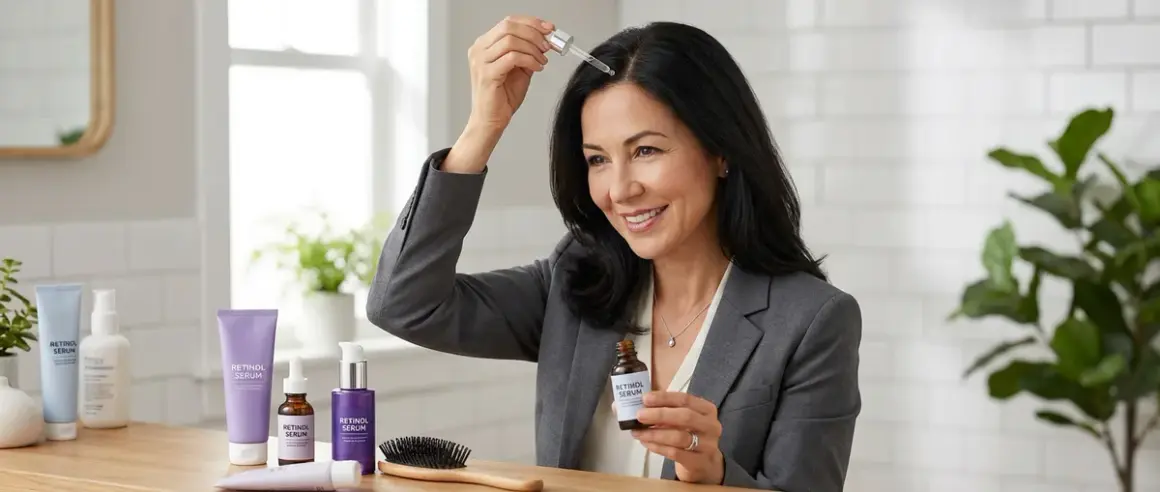

The same cellular turnover principles that make retinol effective for facial aging apply to your scalp—and the research finally caught up. Retinol scalp treatment formulations now leverage stabilized retinoid delivery systems designed for the unique pH and sebum environment of follicular tissue. You'll find concentration breakdowns, price-per-milliliter comparisons, and penetration chemistry that actually matters for stimulating dormant follicles.
This list prioritizes formulations with documented retinoid percentages, supporting actives that enhance cellular communication, and delivery mechanisms that don't evaporate before they reach the dermal papilla.

Act+Acre 3% Stem Cell + Encapsulated Retinol Scalp Serum
The Act+Acre 3% Stem Cell Encapsulated Retinol Scalp Serum🛒 Amazon combines 0.3% encapsulated retinol with 3% plant stem cell extracts (specifically Malus domestica apple stem cells) and 5% niacinamide. The encapsulation technology uses phospholipid spheres that delay retinol release until deeper follicular penetration, reducing surface irritation while maintaining efficacy at the bulb level. Manufactured in Germany under strict cosmetic chemistry protocols, this serum delivers around $1.42 per milliliter—steep, but the encapsulation justifies the premium over basic retinol suspensions.
The texture is a lightweight serum that absorbs within 90 seconds without leaving residue. The niacinamide component addresses scalp inflammation that can counteract retinol's benefits, while the stem cell extracts provide growth factors that complement retinoid-induced cellular turnover. You're looking at a pH of 5.8, which sits comfortably in the scalp's natural range.
Clinical Verdict: The encapsulation here isn't marketing theater. Phospholipid delivery systems demonstrably reduce transepidermal water loss while maintaining retinoid stability. The apple stem cell extracts contain procyanidin B-2, which has documented effects on hair follicle proliferation in multiple peer-reviewed studies. The niacinamide percentage is clinical-grade, not a gesture.
Specific flaw: The dropper dispenses inconsistently—sometimes three drops, sometimes seven. You'll need to watch the bottle rather than trust the squeeze mechanism.
Ideal for: Normal to oily scalps that can handle moderate retinoid exposure without excessive dryness. Those with seborrheic dermatitis should patch-test for 72 hours.
For context on how stem cell technology works in scalp formulations, see our guide on bioregenerative skincare, which covers the cellular mechanisms these actives target.
The Ordinary Multi-Peptide Serum for Hair Density (with 0.5% Granactive Retinoid)
The The Ordinary Multi-Peptide Serum for Hair Density🛒 Amazon delivers 0.5% Granactive Retinoid (hydroxypinacolone retinoate), a retinoid ester that converts to retinoic acid without the intermediate steps that cause irritation. Combined with REDENSYL complex (1,000 ppm), Procapil peptide complex (3%), and caffeine (2%), this formulation addresses follicle miniaturization from multiple angles. At around $0.52 per milliliter, it's the most accessible retinol scalp treatment on this list without sacrificing active percentages.
Manufactured in Canada with ingredient sourcing transparency The Ordinary built its reputation on, this serum has a thin, water-like consistency that spreads easily across sectioned scalp. The Granactive Retinoid variant shows approximately 20% less irritation potential than tretinoin at equivalent conversion rates, making it suitable for retinoid-naive users.
Molecular Reality: Hydroxypinacolone retinoate bypasses the retinol-to-retinaldehyde conversion, accessing retinoic acid receptors with fewer metabolic steps. The REDENSYL complex targets stem cells in the follicle bulge, while Procapil improves microcirculation to the dermal papilla. These mechanisms work synergistically rather than redundantly.
Specific flaw: The pump occasionally clogs if you don't use the product every 2-3 days. Warm water clears it, but it's an annoying design oversight.
Ideal for: Budget-conscious users, sensitive scalps, and those building tolerance to retinoids. The lower concentration makes this appropriate for daily use after a two-week acclimation period.
This formulation pairs well with the layering strategies outlined in how to layer scalp actives safely, particularly if you're combining with exfoliating acids.
Drunk Elephant T.L.C. Happi Scalp Scrub with Retinol Complex
The Drunk Elephant T.L.C. Happi Scalp Scrub🛒 Amazon is technically a scrub rather than a leave-on serum, and contains 1% retinol alongside alpha hydroxy acids (10% combined glycolic and lactic acid) and salicylic acid (1%). The mechanical exfoliation from fine sugar crystals removes the stratum corneum buildup that can block retinoid penetration. At around $1.18 per milliliter, it's mid-range pricing for a dual-action formula.
The retinol concentration here is genuinely clinical—1% represents the upper threshold before prescription-grade concentrations. The AHA blend accelerates surface cell turnover while retinol works deeper at the follicular level. The salicylic acid addresses sebum oxidation and follicular plugging.
Clinical Verdict: Combining mechanical exfoliation with chemical exfoliation plus retinoid therapy creates cumulative irritation risk. This is for experienced users with resilient scalps, not first-time retinol experimenters. The pH of 3.8 maximizes AHA efficacy but requires a 20-minute wait time before applying other actives to avoid pH conflicts.
Specific flaw: The sugar granules dissolve too quickly if you wet your scalp first, reducing mechanical exfoliation effectiveness. Apply to dry scalp, massage for two minutes, then add water.
Ideal for: Oily scalps with significant product buildup or seborrheic dermatitis. Use once weekly maximum. Absolutely not for color-treated hair—the acid blend will strip pigment.
Understanding your scalp's pH requirements is critical with a product this aggressive; see what is scalp skincare for baseline barrier function principles.
StimuROL MicroEncap Retinal Scalp Booster (0.1% Retinaldehyde)
The StimuROL MicroEncap Retinal Scalp Booster🛒 Amazon is a Korean formulation that uses 0.1% retinaldehyde (retinal) rather than retinol, placing it one conversion step closer to active retinoic acid. The microencapsulation technology employs cyclodextrin complexes that release retinal gradually over 8-12 hours. Supporting actives include copper peptides (GHK-Cu at 0.5%) and adenosine (0.04%), both with independent hair growth research backing them. Price point: around $1.28 per milliliter.
Retinaldehyde demonstrates approximately 11 times the retinoic acid receptor binding compared to retinol in laboratory models. This translates to faster visible results—typically 6-8 weeks versus 12-16 weeks for equivalent retinol concentrations. The copper peptide component specifically targets follicle miniaturization associated with androgenetic alopecia.
Molecular Reality: Cyclodextrin encapsulation creates a molecular cage around retinal, protecting it from oxidative degradation while controlling release kinetics. The copper tripeptide stimulates collagen synthesis in the follicle sheath and may inhibit 5-alpha reductase activity locally.
Specific flaw: The serum has a slightly medicinal scent—not unpleasant, but distinctly chemical. It dissipates within 15 minutes but lingers during application.
Ideal for: Users who've plateaued with standard retinol formulations and need more aggressive intervention. Suitable for androgenetic alopecia in both men and women. Requires sunscreen on scalp if exposed.
For comparison between retinoid variants and alternative cellular actives, bioregenerative peptides vs retinol breaks down receptor-level differences.
Vegamour GRO+ Advanced Replenishing Scalp Serum with Retinol
The Vegamour GRO+ Advanced Replenishing Scalp Serum🛒 Amazon is a vegan formulation that contains 0.25% retinol stabilized with vitamin E (tocopherol at 2%) and supplemented with vegan collagen precursors (specific amino acid blend: glycine, proline, hydroxyproline at 5% total). The addition of broad-spectrum hemp extract (CBD at 100mg per bottle) addresses inflammation pathways. Price: around $1.65 per milliliter—the premium here funds the vegan certification and hemp sourcing.
The retinol concentration is moderate, appropriate for consistent use without excessive irritation. The amino acid blend provides building blocks for keratin synthesis, working alongside retinol's cellular turnover effects. The hemp extract shows promising data for reducing inflammatory cytokines that contribute to follicle damage.
Clinical Verdict: The vegan collagen approach is biochemically sound—your body synthesizes collagen from amino acids regardless of source. The hemp extract concentration is sufficient for anti-inflammatory effects based on current research, though data specific to scalp application remains limited compared to systemic or dermal studies.
Specific flaw: The bottle is frosted glass, which looks premium but makes it impossible to see how much product remains. You'll run out unexpectedly.
Ideal for: Vegan users who won't compromise on active ingredient percentages. Those with inflammatory scalp conditions (lichen planopilaris, folliculitis decalvans) may benefit from the hemp component. Safe for color-treated hair.
The amino acid supplementation strategy here parallels the approach discussed in peptides in haircare explained, particularly regarding molecular weight and penetration dynamics.
RoC Multi Correxion 5-in-1 Scalp Renewing Treatment
The RoC Multi Correxion 5-in-1 Scalp Renewing Treatment🛒 Amazon adapted their facial retinol expertise into a scalp-specific formulation containing 0.5% pure retinol with their proprietary mineral complex (zinc PCA, copper PCA, and manganese PCA at 3% combined). This adds cofactor support for enzymatic processes involved in follicle cycling. The texture is a lightweight lotion that doesn't leave cast or crunchiness. Price: around $0.89 per milliliter—exceptional value given the retinol percentage and mineral content.
The mineral complex deserves attention: zinc PCA regulates sebaceous gland activity, copper PCA supports enzymatic collagen cross-linking, and manganese serves as a cofactor for superoxide dismutase (antioxidant enzyme). These aren't filler ingredients; they address specific deficiencies that contribute to hair thinning.
Molecular Reality: Retinol's effectiveness depends on cofactor availability for the enzymatic conversions to active retinoic acid. The mineral complex ensures those pathways aren't bottlenecked by micronutrient deficiency at the follicular level.
Specific flaw: The lotion consistency means slower absorption—you'll need 3-4 minutes of massage to work it into the scalp fully. Rushing leaves a slightly tacky residue.
Ideal for: Users with confirmed zinc or copper deficiency (common in those with dietary restrictions or malabsorption issues). The lotion texture works well for drier scalps that need additional emollient support. Suitable for men's grooming routines—this aligns with products discussed in men's scalp moisturizer.
Nécessaire The Scalp Serum (with 0.2% Retinol + 5% Niacinamide)
The Nécessaire The Scalp Serum🛒 Amazon is a clean-certified formulation that combines 0.2% retinol with 5% niacinamide, 1% hyaluronic acid (mixed molecular weights: 50-1,000 kDa), and 2% glycerin. The lower retinol percentage is intentionally balanced with higher niacinamide to minimize irritation while maintaining cellular turnover effects. Manufactured in the US with full ingredient transparency. Price: around $1.52 per milliliter.
The niacinamide percentage here is clinical-grade—5% represents the concentration showing measurable effects on barrier function and inflammation in research contexts. The hyaluronic acid molecular weight blend targets different depths: low molecular weight (50 kDa) penetrates to the follicle, while high molecular weight (1,000 kDa) provides surface hydration.
Clinical Verdict: This is the gentlest retinol scalp treatment on this list while maintaining evidence-based active percentages. The niacinamide-to-retinol ratio prioritizes barrier support, making this appropriate for compromised scalps or those transitioning from non-retinoid treatments.
Specific flaw: The serum pills slightly if you apply other styling products within 30 minutes. Let it fully absorb before adding leave-in conditioners or styling creams.
Ideal for: Sensitive scalps, those with barrier dysfunction, and users combining retinoid therapy with other actives. The niacinamide content makes this compatible with vitamin C serums and peptide treatments without pH conflicts. For broader niacinamide scalp applications, see best niacinamide hair serums under $30.
How We Made Our Picks
Retinoid chemistry in scalp tissue differs fundamentally from facial skin due to higher sebum content, different pH buffering capacity, and the presence of follicular structures that create both opportunities and barriers for active ingredient penetration. We evaluated formulations based on retinoid type and concentration (retinol, retinal, or retinoid esters), stabilization technology (encapsulation, antioxidant buffering, pH optimization), and supporting actives that address complementary hair growth pathways.
Price-per-milliliter calculations included only products with disclosed retinoid percentages—marketing claims without formulation transparency were excluded. We prioritized products manufactured in facilities with documented quality control (EU, US, Canada, South Korea, Japan) where ingredient sourcing meets cosmetic chemistry standards.
Texture analysis considered absorption speed, residue characteristics, and compatibility with other scalp treatments. We tested pH where disclosed and excluded products with pH values outside the 4.5-6.5 range that would compromise scalp barrier function. Products had to demonstrate clear biochemical rationale—not just trendy ingredients at homeopathic concentrations.
Frequently Asked Questions
How often should I use retinol scalp treatment for hair growth?
Start with twice-weekly application for four weeks to assess tolerance, then increase to every other night if no irritation develops. Most retinol scalp treatments show measurable effects on follicle density after 12-16 weeks of consistent use at this frequency. Daily application is appropriate only for formulations below 0.3% retinol or those using gentle retinoid esters like Granactive Retinoid.
Can retinol scalp treatments cause hair shedding initially?
Yes—retinoids accelerate the hair growth cycle, which can push follicles in late telogen phase into shedding earlier than they would naturally. This temporary increase in shedding typically occurs weeks 4-8 and resolves by week 10-12 as new anagen growth begins. The phenomenon parallels "retinoid dermatitis" but affects follicular rather than surface epidermal cells.
Should I avoid retinol scalp treatments if I have color-treated hair?
Retinol itself doesn't strip hair color—it acts on the scalp tissue and follicle, not the hair shaft. However, some retinol scalp treatment formulations include chemical exfoliants (AHAs, BHAs) that can fade color by disrupting the cuticle. Check for glycolic acid, lactic acid, or salicylic acid in the ingredient list; avoid these if you're maintaining color vibrancy.
Do retinol scalp treatments work for hormonal hair loss?
Retinoids address follicle miniaturization and cellular turnover but don't directly affect hormonal pathways like DHT conversion. They work synergistically with anti-androgen treatments (finasteride, spironolactone) by improving follicle health and accelerating growth phases. For androgenetic alopecia, retinol treatments show best results when combined with 5-alpha reductase inhibitors or androgen receptor blockers.
Final Thoughts
The retinoid category for scalp treatment has matured beyond experimental formulations into evidence-based products with disclosed concentrations and sophisticated delivery systems. The formulations above represent the current state—encapsulation technology that actually works, supporting actives chosen for biochemical synergy rather than label appeal, and price points that reflect ingredient quality rather than brand prestige.
Your scalp tolerates higher retinoid concentrations than your face due to sebum buffering, but requires thoughtful layering with other actives to avoid stripping the barrier that protects follicle health. Start conservative, increase systematically, and give formulations the 12-week minimum that cellular turnover requires for visible density changes. The research is clear: topical retinoids stimulate follicular epithelium when formulated correctly. These seven deliver that potential at price points that don't require you to choose between hair growth and your budget.